Chloroplast

Example:
Imagine trying to charge your phone when you're out and about, but you can't find an outlet anywhere. This situation is similar to how plants need to convert sunlight into energy when there's no ready-made food around. Just like you rely on a solar power bank to harness sunlight and charge your device, chloroplasts in plant cells capture light energy to produce food in the form of glucose. In this analogy, your phone is like the plant needing energy, the solar power bank is the chloroplast, and the sunlight is the energy source both rely on to keep functioning.
Practice Version

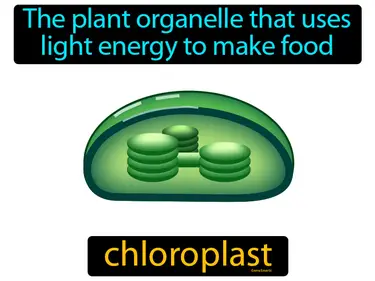
Chloroplast: The plant organelle that uses light energy to make food. Chloroplast. Chloroplasts are parts of plant cells where photosynthesis happens, turning sunlight into food.