Conic Projection
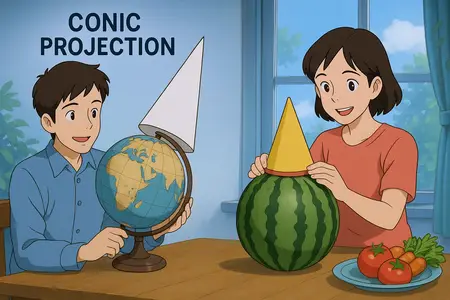
Example:
Imagine trying to wrap a party hat around a small, round watermelon to decorate it. This is similar to how a conic projection works, as it involves fitting a flat surface (the cone) around a curved one (the globe) and then unfolding it to create a map. Just like aligning the cone's tip with the top of the watermelon and making sure the sides fit snugly around it, a conic projection aligns the cone with a specific latitude on the globe and projects lines outward to accurately represent areas on a flat map.
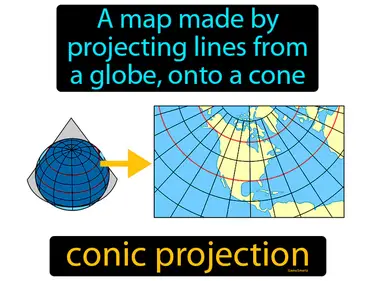
Practice Version

Conic Projection: A map made by projecting lines from a globe onto a cone. Conic projection is a method in cartography where the Earth's surface is projected onto a conical surface, helping to accurately represent mid-latitude areas.