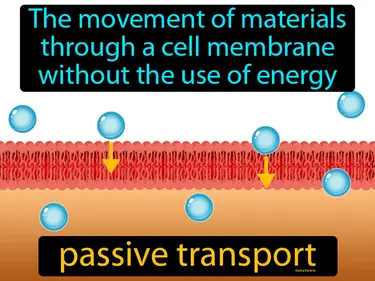
Passive Transport

Example:
Imagine standing at a crowded concert, trying to move closer to the stage without pushing or forcing your way through. Just like how you slowly make your way forward by simply following the flow of the crowd, passive transport involves materials moving through a cell membrane naturally, without any extra effort or energy. In this scenario, the crowd represents molecules, the concert venue is like the cell, and your gentle drift toward the stage is akin to the effortless movement of molecules across the cell membrane, driven by concentration differences rather than force.
Practice Version

Passive Transport: The movement of materials through a cell membrane without the use of energy. Passive transport. It is how particles move naturally from high to low concentration in cells without energy.