Pascals Principle

Example:
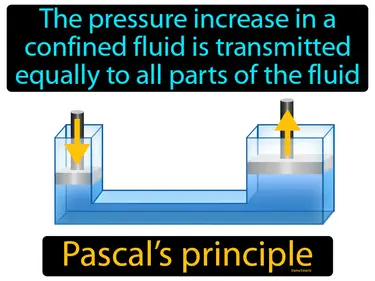
Imagine you're blowing up a balloon, and you notice that it expands evenly in all directions, not just where you're blowing into it. This is similar to Pascal's principle, which states that when you increase the pressure in a confined fluid, that pressure is distributed equally throughout the fluid. Just like your breath makes the entire balloon expand uniformly, an increase in pressure at one point in a fluid leads to an equal increase in pressure throughout the fluid, ensuring that every part of the liquid feels the same "push" from the pressure change.
Practice Version

Pascals Principle: The pressure increase in a confined fluid is transmitted equally to all parts of the fluid. Pascal's principle states that when pressure is applied to a fluid in a closed system, it is distributed evenly throughout the fluid.