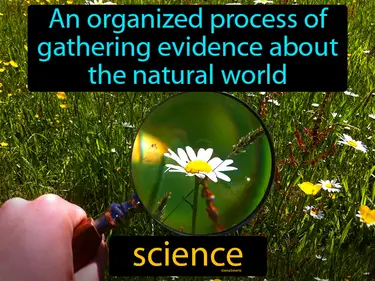
Science

Example:
Imagine you're planning a road trip to a place you've never been before. Just like planning this trip, where you gather maps, check the weather forecast, and make a list of things to pack, science involves an organized process of gathering evidence about the natural world. In both scenarios, you're collecting and organizing information to make informed decisions—whether it's to ensure a smooth journey or to understand the world around us better. The maps and weather forecasts are like scientific data, the packing list is akin to a hypothesis, and the road trip itself is the experiment that tests your preparation, showing how both processes aim to achieve clarity and understanding through careful planning and evidence collection.
Practice Version

Science: An organized process of gathering evidence about the natural world. Science. Science is the systematic study of the structure and behavior of the physical and natural world through observation and experiment.