Crater

Example:
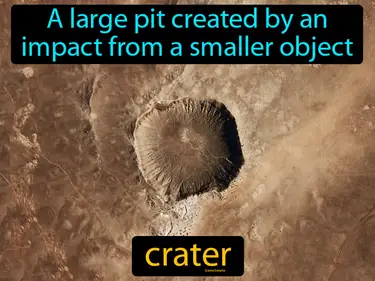
Imagine you're at a beach, and you watch as a child throws a stone into the sand, creating a small depression where it lands. This scene is quite similar to how craters form on Earth or other celestial bodies when a smaller object, like a meteor, strikes their surface and creates a large pit. Just as the stone disrupts the smooth surface of the sand by transferring its energy into the ground and pushing the particles aside, a meteor impacts a planet's surface, transferring its kinetic energy, displacing material, and forming a crater.
Practice Version

Crater: A large pit on Earth or any object in space, created by an impact from a smaller object. Crater. A crater is a bowl-shaped depression formed when a meteorite or other object hits a surface.