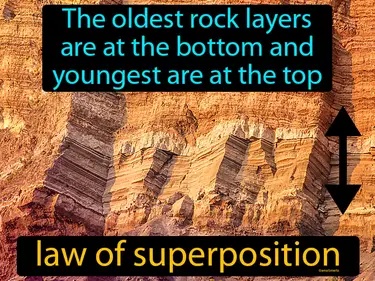
Law Of Superposition

Example:
Imagine you have a pile of laundry where you keep adding your freshly washed clothes on top of the old ones. Over time, the clothes you first put at the bottom of the pile are the ones you haven’t worn in a while, while the newer clothes are on top, ready to grab. This is similar to the law of superposition in geology, where the oldest rock layers are at the bottom of a sequence and the youngest are at the top. Just like your laundry pile where the oldest clothes are buried underneath the newer additions, in rock formations, the oldest layers are found deeper down, with newer layers stacked above them over time.
Practice Version

Law Of Superposition: The oldest rock layers are at the bottom and youngest are at the top. Law of superposition. This law states that in undisturbed sedimentary rock layers, the layers on the bottom are older than those on top.