Efficiency

Example:
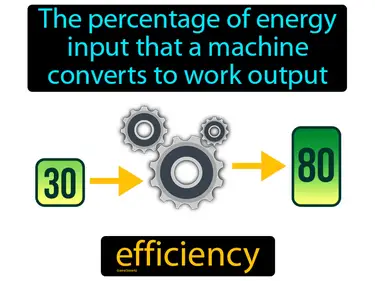
Imagine you're trying to fill a leaky bucket with water, but no matter how much water you pour in, only a portion stays inside while the rest spills out. This is similar to how a machine converts energy input into work output, where only a certain percentage of the energy is efficiently used while the rest is lost, often as heat or sound. Just as the leaky bucket only holds onto some of the water you add, a machine only converts a portion of the energy it receives into useful work, highlighting the concept of efficiency as the percentage of energy input that is successfully transformed into work output.
Practice Version

Efficiency: The percentage of energy input that a machine converts to work output. Efficiency. Efficiency measures how well a machine or system converts energy into useful work.