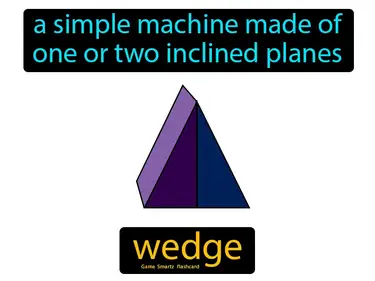
Wedge
This knowledge is used in careers such as:
Mechanical Engineer (Designs Machines) ~$65,000 - $115,000 - Number of jobs: 290,000 (18,100 Openings Per Year) +9% Growth
Civil Engineer (Designs Infrastructure) ~$65,000 - $110,000 - Number of jobs: 370,000 (23,600 Openings Per Year) +5% Growth
Industrial Technician (Maintains & Repairs Machines) ~$50,000 - $75,000 - Number of jobs: 540,000 (54,000 Openings Per Year) +13% Growth
Carpenter (Builds and Repairs Framing and Walls in Buildings) ~$50,000 - $75,000 - Number of jobs: 960,000 (74,100 Openings Per Year) +4% Growth
Electrician (Installs & Repairs Electrical Systems in Buildings) ~$50,000 - $90,000 - Number of jobs: 820,000 (81,000 Openings Per Year) +9% Growth
Explore These Careers →

Example:
Imagine trying to split a log of wood with an axe. This task is similar to how a wedge works as a simple machine. Just as the sharp edge of the axe (the wedge) is driven into the log to separate it into pieces, the wedge’s inclined planes exert force on the material to divide it, making it easier to split. Here, the edge of the axe represents the wedge, while the force applied to the axe corresponds to how the inclined planes of the wedge help separate the wood with less effort.
Practice Version

Wedge: A simple machine made of one or two inclined planes. Wedge. A wedge is a tool used to split or lift objects apart by converting force applied to its wide end into force at its narrow end.