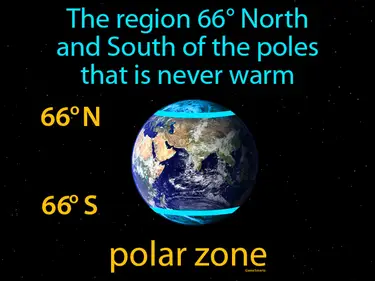
Polar Zone

Example:
Imagine trying to warm up a room when the heater is only on the opposite side of the house. Just like the room struggles to get warm due to the distance from the heat source, the polar zones at 66° North and South of the poles never get warm because they are far from the equator, which is like the Earth's heater. In this analogy, the equator acts as the central heating system, the warmest point on Earth, while the polar zones are like the distant room, too far from the heat source to ever truly warm up.
Practice Version

Polar Zone: The region 66 North and South of the poles that is never warm. Polar zone. The polar zone is the icy, cold area around the North and South Poles where the sun's rays are weak, leading to low temperatures.