Lightning

Example:
Imagine you're at a party where everyone is having a great time, but there's one person who suddenly feels a strong urge to sneeze. This buildup of pressure and the eventual sneeze is similar to how lightning works, where charges accumulate within a cloud or between clouds and the ground until they suddenly discharge. Just like the tension and release of a sneeze, lightning occurs when the electrical charges build up to a point where they can't hold back anymore, resulting in a sudden leap of energy to restore balance, much like a sneeze releases the built-up pressure in your nose.
Practice Version

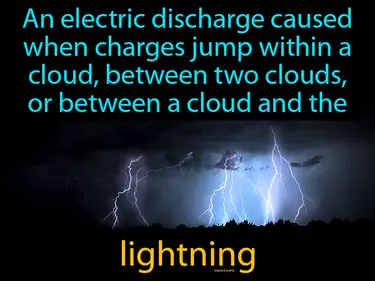
Lightning: An electric discharge caused when charges jump within a cloud, between two clouds, or between a cloud and the ground. Lightning is a sudden flash of light in the sky caused by electricity moving in the atmosphere.