Wind Chill Factor
This knowledge is used in careers such as:
Teacher (Teaches Students) ~$55,000 - $95,000 - Number of jobs: 4,700,000 (324,500 Openings Per Year) +2% Growth
Civil Engineer (Designs Infrastructure) ~$65,000 - $110,000 - Number of jobs: 370,000 (23,600 Openings Per Year) +5% Growth
Electrical Engineer (Designs Electrical Systems) ~$65,000 - $115,000 - Number of jobs: 295,000 (17,500 Openings Per Year) +7% Growth
Mechanical Engineer (Designs Machines) ~$65,000 - $115,000 - Number of jobs: 290,000 (18,100 Openings Per Year) +9% Growth
Industrial Technician (Maintains & Repairs Machines) ~$50,000 - $75,000 - Number of jobs: 540,000 (54,000 Openings Per Year) +13% Growth
Explore These Careers →

Example:
Imagine sitting in a room with a fan on while trying to enjoy a bowl of hot soup. Just like how the fan cools the soup faster by blowing air over it, wind chill factor describes how wind makes cold temperatures feel even colder on our skin. The fan represents the wind, the soup is like our skin, and together, they illustrate how moving air accelerates the cooling effect, making us feel colder than the actual air temperature might suggest.
Practice Version

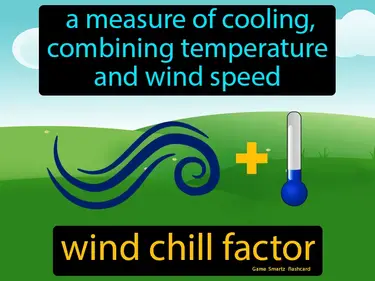
Wind Chill Factor: A measure of cooling, combining temperature and wind speed. Wind chill factor. It describes how cold it feels on your skin when the wind is blowing.