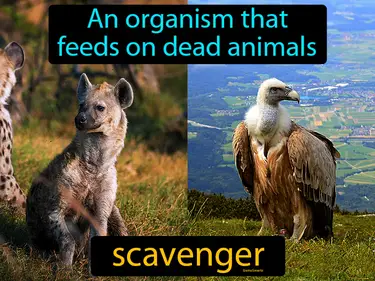
Scavenger

Example:
Imagine you're at a party, and by the time you arrive, most of the food has already been eaten by the guests who came earlier. In this scenario, you find yourself scavenging through what's left on the buffet table, picking at whatever leftovers you can find to satisfy your hunger. This is similar to how scavengers in nature operate, as they feed on animals that are already dead, rather than hunting for fresh prey. Just as you rely on what's left at the party to fill your stomach, scavengers depend on the remains of deceased animals to sustain themselves, making efficient use of available resources rather than seeking out fresh ones.
Practice Version

Scavenger: An organism that feeds on animals that are already dead. Scavenger. Scavengers are animals that eat dead organisms that they did not hunt or kill themselves.