Astronomy
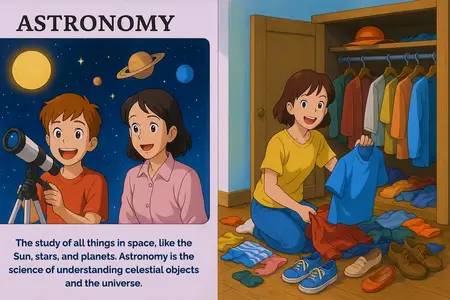
Example:
Imagine trying to organize your closet where everything from clothes to shoes is scattered all over. Just as you would sort and understand what each item is and where it belongs in your closet, astronomy involves categorizing and studying the Sun, stars, and planets to understand their roles and positions in the universe. In this analogy, your scattered closet represents the vast universe, and organizing it is like astronomers studying space to make sense of the cosmic "items" — identifying the "shirts" as stars, the "shoes" as planets, and the "hats" as the Sun, each with its own unique place and function.
Practice Version

Astronomy: The study of all things in space, like the Sun, stars, and planets. Astronomy is the science of understanding celestial objects and the universe.