Nuclear Fission

Example:
Imagine trying to untangle a tightly knotted ball of yarn that's been sitting in your drawer for years. Just like when you finally pull apart that stubborn knot, releasing a cascade of smaller, more manageable strands of yarn, nuclear fission involves splitting a tightly bound atomic nucleus into smaller nuclei and neutrons. The energy released when the knot is untangled, allowing the yarn to flow freely, is like the energy released during nuclear fission when the nucleus splits, freeing up energy that was previously trapped in that tight configuration.
Practice Version

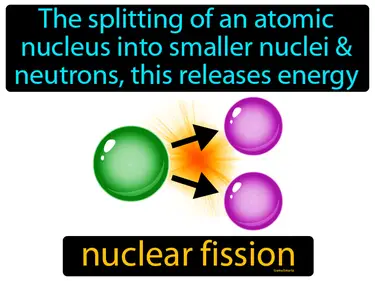
Nuclear Fission: The splitting of an atomic nucleus into smaller nuclei and neutrons, this releases energy. Nuclear fission. In simple terms, nuclear fission is when an atom's core breaks apart, releasing a lot of energy.