Apparent Magnitude
Example:
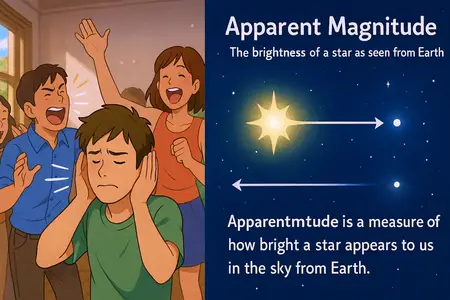
Imagine trying to choose the loudest person at a crowded party, where some people are shouting right next to you and others are speaking quietly from across the room. Just like the apparent loudness of someone's voice depends on their distance from you and how loudly they're actually speaking, the apparent magnitude of a star is how bright it seems from Earth, influenced by both its intrinsic brightness and how far away it is. In this analogy, the people at the party are the stars, their voices are their intrinsic brightness, and your perception of their loudness is the apparent magnitude, which helps you decide who seems loudest based on proximity and volume.
Practice Version

Apparent Magnitude: The brightness of a star as seen from Earth. Apparent magnitude. Apparent magnitude is a measure of how bright a star or celestial object appears from Earth.