Semiconductor
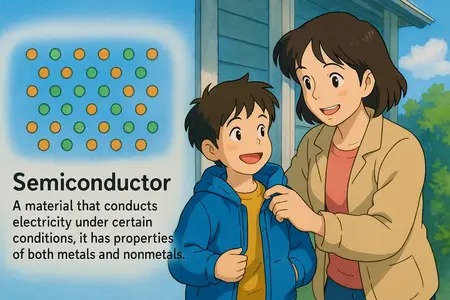
Example:
Imagine trying to decide whether to wear a jacket when the weather is unpredictable; sometimes it's warm and sometimes it's cool. This is similar to how a semiconductor behaves, as it can conduct electricity like a metal when conditions are right (just like wearing a jacket when it's cold), but resist electricity like a nonmetal under different conditions (like not wearing a jacket when it's warm). Just like you assess the weather to decide on wearing a jacket, semiconductors assess their environment, such as temperature or voltage, to determine whether they should conduct electricity or not, balancing between the properties of metals and nonmetals.
Practice Version
Semiconductor: A material that conducts electricity under certain conditions, it has properties of both metals and nonmetals. Semiconductor. A semiconductor is a substance that can control the flow of electricity, making it essential in electronic devices.