Polyatomic Ion

Example:
Imagine trying to carry a stack of groceries with various items balanced precariously in your arms. Just like these groceries, which are a collection of different items that you must manage together, a polyatomic ion is a group of different atoms bonded together, carrying a collective charge. Just as the groceries might feel heavier or lighter depending on what's in the stack, a polyatomic ion may have a positive or negative charge depending on the balance of electrons among the atoms, all moving as a single unit.
Practice Version

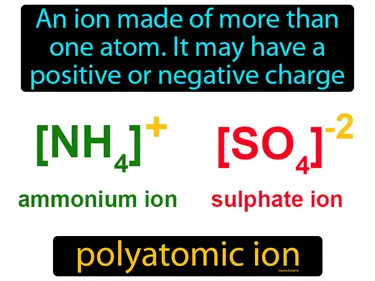
Polyatomic Ion: An ion made of more than one atom, it may have a positive or negative charge. Polyatomic ion. A polyatomic ion is a group of atoms bonded together that carries an overall charge.