Hybridization
Hybridization:
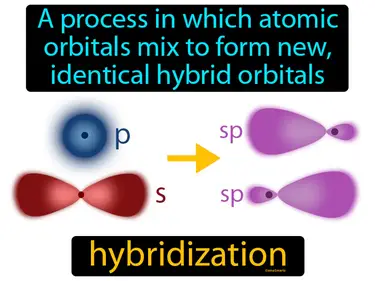
Imagine trying to organize a cluttered kitchen drawer filled with different utensils. In order to make the drawer more functional, you might decide to group these utensils into specific categories, like spoons, forks, and knives, and then rearrange them in matching compartments for easier access. Similarly, in hybridization, atomic orbitals (like the cluttered utensils) mix and reorganize to form new, identical hybrid orbitals (like the organized compartments) that are more efficient and ready for bonding. Just as the newly organized drawer allows you to find what you need quickly, hybrid orbitals allow atoms to form stable bonds by providing uniform spaces for electrons to pair up with those from other atoms.
Practice Version

Hybridization: A process in which atomic orbitals mix to form new, identical hybrid orbitals. Hybridization. Hybridization is when atoms blend their orbitals to make new ones that help them bond better with other atoms.