Dispersion Force
Dispersion Force:
Imagine trying to keep a stack of loose papers neatly organized on a windy day. Just as the wind can temporarily shift the papers, causing them to flutter and create little gaps or overlaps, electrons in atoms can shift, creating temporary charged regions. These temporary charges in atoms lead to weak attractions, much like the way a small gust of wind can momentarily pull paper edges together or apart. Just as the wind's effect is temporary and fluctuating, so too is the interaction between atoms due to the shifting electrons, leading to what's known as dispersion forces.
Practice Version

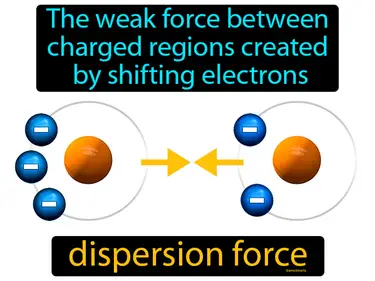
Dispersion Force: The weak force between charged regions created by shifting electrons. Dispersion force. A dispersion force is a weak attraction between molecules due to temporary shifts in electron density.