Addition Polymerization
Addition Polymerization:
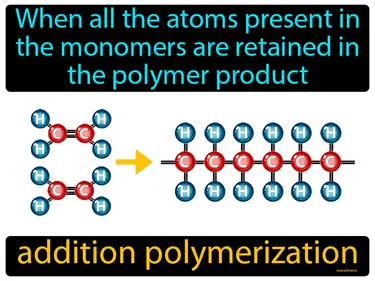
Imagine you're trying to piece together a jigsaw puzzle where every piece perfectly fits together without leaving any gaps or needing to be altered. This is similar to addition polymerization, where individual monomer units connect end-to-end, retaining all their original components in the final polymer chain. Just like in the jigsaw puzzle, where each piece retains its shape and edges to complete the picture, in addition polymerization, each atom in the monomer is preserved and used to build the complete polymer, ensuring nothing is wasted and everything fits seamlessly together.
Practice Version

Addition Polymerization: When all the atoms present in the monomers are retained in the polymer product. Addition polymerization. Addition polymerization is a process where small molecules, called monomers, join together to form a large chain without losing any atoms.