38th Parallel
38th Parallel:
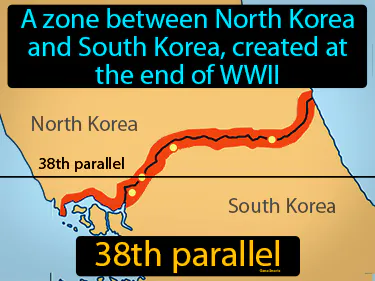
The 38th parallel became important during the Cold War as it marked the division between communist North Korea and democratic South Korea, highlighting the global struggle between communism and democracy. This division led to the Korean War (1950-1953), which intensified Cold War tensions and underscored the ideological conflict between the United States and the Soviet Union. These tensions are still relevant today, as North and South Korea remain divided, and periodic conflicts continue to affect international relations. The ongoing division influences global politics, military spending, and alliances, which can impact economies and security worldwide. For an average person, this can mean fluctuations in global markets or changes in international policies that affect travel, trade, and even everyday items like electronics, many of which are produced in South Korea.
Practice Version

38th Parallel: A zone between North Korea and South Korea, created at the end of WWII. 38th parallel. The 38th parallel is the latitude line that roughly marks the border between North and South Korea, established to separate the two after World War II.