Second Law Of Thermodynamics
Second Law Of Thermodynamics:
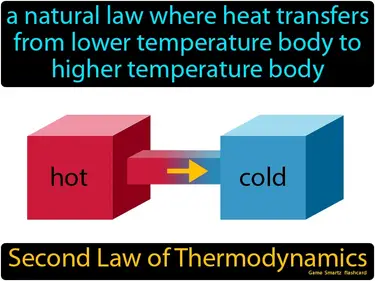
Imagine trying to push a heavy boulder uphill without any help. Just like how it's unnatural for a boulder to spontaneously roll uphill, it's against the natural order for heat to move from a cooler object to a warmer one. In both cases, there's a preferred direction: the boulder wants to roll downhill just as heat naturally flows from a hot body to a cooler one, aligning with the Second Law of Thermodynamics which states that without external work, heat will not transfer from a lower temperature body to a higher temperature body.
Practice Version

Second Law Of Thermodynamics: A natural law where heat transfers from lower temperature body to higher temperature body. Second Law of Thermodynamics. The Second Law of Thermodynamics states that energy naturally spreads out and becomes more disordered over time.