Energy Absorption

Example:
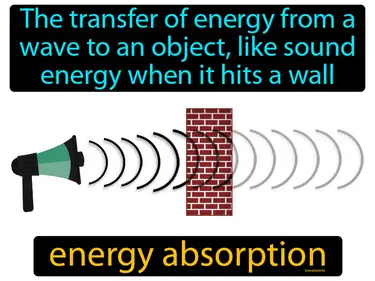
Imagine trying to carry a large load of groceries from your car to your kitchen in one trip. Just as the groceries are transferred from your arms to the counter, energy from a wave, such as sound, is transferred to an object, like a wall. In both cases, there's a transfer of something from one point to another—groceries to the counter, and energy to the wall—where the object receiving the load (your counter or the wall) has to 'absorb' and 'hold' what is being transferred (groceries or energy).
Practice Version

Energy Absorption: The transfer of energy from a wave to an object, like sound energy when it hits a wall. Energy absorption. In simple terms, energy absorption is when an object takes in the energy from a wave or impact, reducing the energy's effect elsewhere.