Water Table

Example:
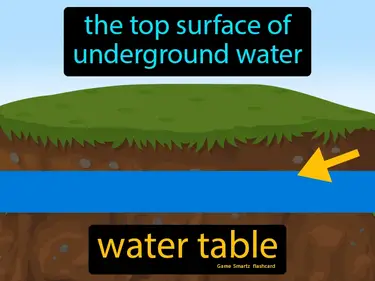
Imagine trying to fill a sponge with water, only to find that after a certain point, all the water starts pooling on the surface instead of being absorbed. This situation is similar to how the water table works, where the ground can only absorb so much water before reaching a point where it can't hold any more, and the excess water remains at the top. In this analogy, the sponge represents the ground, the absorbed water represents underground water, and the pooled water on the surface symbolizes the water table, which is the top surface of this underground saturation.
Practice Version

Water Table: The top surface of underground water. Water table. The water table is the upper level of groundwater in soil or rock, where the ground is saturated with water.