Sill

Example:
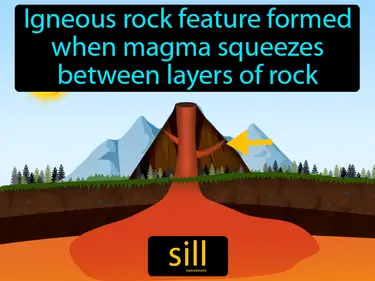
Imagine you're trying to fit a thick book onto an already full bookshelf, and you end up sliding it horizontally between two existing rows of books. This scenario is similar to a geological process where magma finds its way between existing layers of rock, cooling and solidifying to form what's known as a sill. Just like the book that wedges itself between rows without displacing them, a sill forms when magma squeezes into horizontal spaces between rock layers, eventually cooling to create a solid, horizontally-oriented feature.
Practice Version

Sill: Igneous rock feature formed when magma squeezes between layers of rock. Sill. A sill is a flat layer of rock formed when magma cools and hardens between older layers of earth.