Sonar

Example:
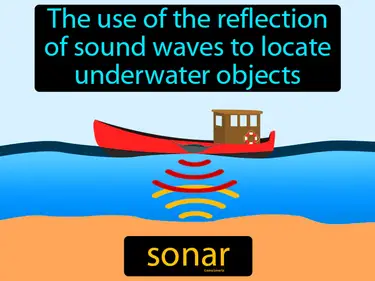
Imagine trying to find your keys in a dark room by clapping your hands and listening for the sound bouncing off objects. This is similar to how sonar works, where sound waves are emitted underwater and their echoes are used to detect objects. Just like your clapping creates sound waves that reflect off your keys and other items to reveal their location, sonar uses the reflection of sound waves to locate underwater objects by interpreting the returning echoes.
Practice Version

Sonar: The use of the reflection of sound waves to locate underwater objects. Sonar. Sonar is a technology that uses sound waves to detect and locate objects underwater.