Surface Tension

Example:
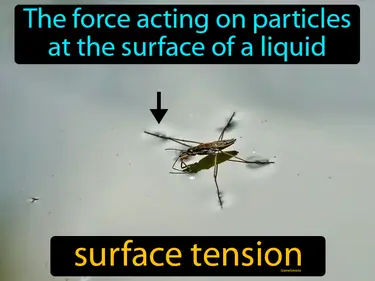
Imagine trying to keep a group of friends together at a crowded party. Just like how you need to hold hands with those around you to maintain your group and not get separated, the particles on the surface of a liquid "hold hands" with each other to stay together, creating a surface layer. The force you exert to keep your friends together at the party is similar to surface tension, which is the force acting on particles at the surface of a liquid to keep them connected and intact.
Practice Version

Surface Tension: The force acting on particles at the surface of a liquid surface tension. Surface tension is the effect where the surface of a liquid acts like a thin, stretchy skin due to the attraction between its molecules.