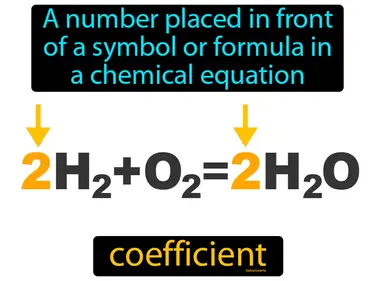
Coefficient

Example:
Imagine you're organizing a party and need to decide how many pizzas to order based on the number of guests. Just like how you determine the quantity of pizzas needed to feed everyone, coefficients in a chemical equation tell you how many molecules or moles of a substance are required for a reaction. In both cases, the number in front (whether it's pizzas for guests or coefficients for molecules) ensures everything is balanced and that there is enough to go around, showing that both scenarios involve making sure quantities match the needs of the situation.
Practice Version

Coefficient: A number placed in front of a symbol or formula in a chemical equation. Coefficient. In Science, a coefficient is a number that shows how many molecules or atoms are involved in a chemical reaction.