Decomposition

Example:
Imagine you have a tangled set of earphones in your pocket, and you need to unravel them to use them. This process of untangling the earphones is similar to the chemical breakdown of a substance into simpler substances. Just as you carefully separate each knot and loop to get individual wires, in decomposition, a complex chemical compound is broken down into simpler, more manageable components. In both scenarios, you start with a complex, intertwined structure and end up with simpler, distinct parts, whether it's untangled earphones or basic chemical elements.
Practice Version

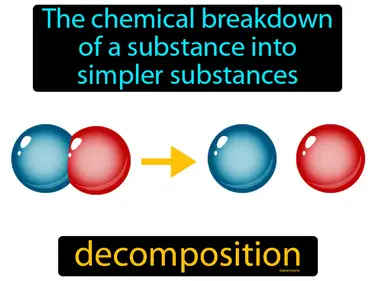
Decomposition: The chemical breakdown of a substance into simpler substances. Decomposition is when complex materials break down into simpler parts, like a fallen leaf rotting into soil nutrients.