Chemical Change

This knowledge is used in careers such as:

Teacher (Teaches Students) ~$55,000 - $95,000 - Number of jobs: 4,700,000 (324,500 Openings Per Year) +2% Growth

Industrial Technician (Maintains & Repairs Machines) ~$50,000 - $75,000 - Number of jobs: 540,000 (54,000 Openings Per Year) +13% Growth

Civil Engineer (Designs Infrastructure) ~$65,000 - $110,000 - Number of jobs: 370,000 (23,600 Openings Per Year) +5% Growth

Electrical Engineer (Designs Electrical Systems) ~$65,000 - $115,000 - Number of jobs: 295,000 (17,500 Openings Per Year) +7% Growth

Mechanical Engineer (Designs Machines) ~$65,000 - $115,000 - Number of jobs: 290,000 (18,100 Openings Per Year) +9% Growth

Explore These Careers →

Chemical Change Meaning

Example:

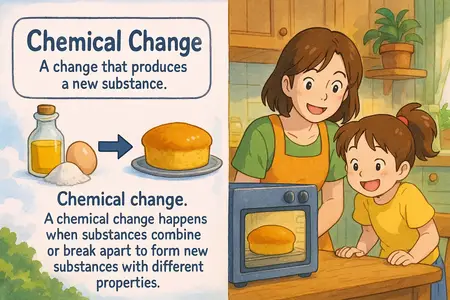
Imagine you're baking a cake and once it's in the oven, there's no way to return it to its original ingredients like flour, eggs, and sugar. This is similar to a chemical change, where substances interact to create a completely new substance, much like how baking transforms your ingredients into a cake. Just as you can't extract raw eggs or flour from a finished cake, a chemical change is irreversible and results in the formation of a new substance, highlighting how the process fundamentally alters the original materials.
Chemical Change Definition

Practice Version

Chemical Change Definition

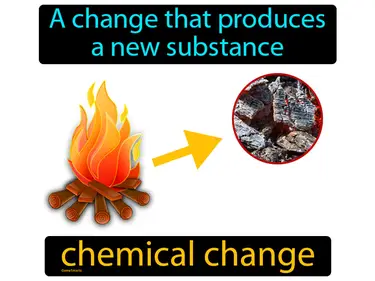
Chemical Change: A change that produces a new substance. Chemical change. A chemical change is when substances combine or break apart to form new substances with different properties.

YouTube Video: