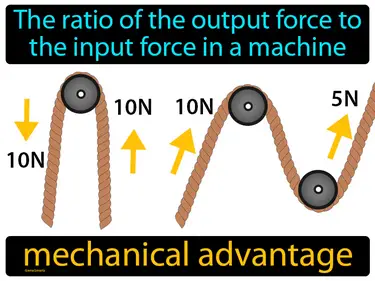
Mechanical Advantage

Example:
Imagine trying to open a tightly sealed jar with just your bare hands. Just like using a rubber jar opener to gain a better grip and increase your hand's effectiveness, mechanical advantage is about using a machine to multiply your input force to achieve a greater output force. In this scenario, your hand is the input force, the rubber jar opener is the machine, and the increased grip and torque you gain is the output force that makes opening the jar easier, illustrating how mechanical advantage allows you to exert less effort for more significant results.
Practice Version

Mechanical Advantage: The ratio of the output force to the input force in a machine is the mechanical advantage. It tells you how much a machine can multiply your effort to make tasks easier.