Mechanical Energy

This knowledge is used in careers such as:

Teacher (Teaches Students) ~$55,000 - $95,000 - Number of jobs: 4,700,000 (324,500 Openings Per Year) +2% Growth

Civil Engineer (Designs Infrastructure) ~$65,000 - $110,000 - Number of jobs: 370,000 (23,600 Openings Per Year) +5% Growth

Electrical Engineer (Designs Electrical Systems) ~$65,000 - $115,000 - Number of jobs: 295,000 (17,500 Openings Per Year) +7% Growth

Mechanical Engineer (Designs Machines) ~$65,000 - $115,000 - Number of jobs: 290,000 (18,100 Openings Per Year) +9% Growth

Industrial Technician (Maintains & Repairs Machines) ~$50,000 - $75,000 - Number of jobs: 540,000 (54,000 Openings Per Year) +13% Growth

Explore These Careers →

Mechanical Energy Meaning

Example:

Imagine you're trying to balance your monthly budget between spending and saving. This is similar to how mechanical energy works, as it combines two different forms, kinetic energy (like your immediate spending) and potential energy (like your savings). Just as you need to manage both your expenses and savings to maintain financial stability, mechanical energy is the sum of an object's kinetic energy (its motion) and potential energy (its stored energy), ensuring the total energy remains constant in a system.
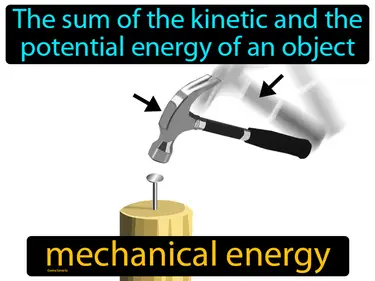
Mechanical Energy Definition

Practice Version

Mechanical Energy Definition

Mechanical Energy: The sum of the kinetic and the potential energy of an object. Mechanical energy. In simple terms, mechanical energy is the energy that an object has because of its motion or position.

YouTube Video: