Standing Wave

Example:
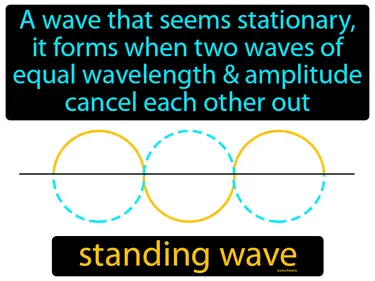
Imagine you're trying to balance a seesaw with two people of equal weight sitting at opposite ends. This situation is similar to a standing wave because just as the seesaw remains level and stationary when both people balance each other out, a standing wave appears stationary when two waves of equal wavelength and amplitude travel in opposite directions and cancel each other out. The seesaw represents the medium (like a string or air column), the people are analogous to the waves, and their balanced state mirrors the stable, stationary pattern of a standing wave.
Practice Version

Standing Wave: A wave that seems stationary, it forms when two waves of equal wavelength and amplitude cancel each other out. Standing wave. In simple terms, a standing wave is a pattern created when two identical waves pass through each other, appearing to stand still.