Rarefaction

Example:
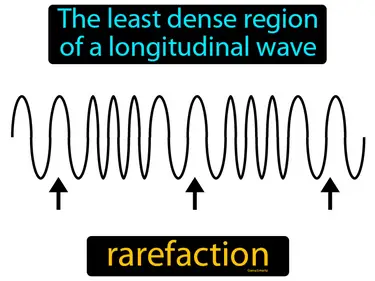
Imagine you're in a crowded elevator, and as it stops at a floor, a few people step out, giving everyone a bit more breathing room. This moment of relief, where there's suddenly more space and less pressure, is similar to the concept of rarefaction in a longitudinal wave. Just as the elevator becomes less crowded when people leave, creating a region of lower density and pressure, rarefaction occurs in a wave when particles are spread apart, creating the least dense part of the wave.
Practice Version

Rarefaction: The least dense region of a longitudinal wave rarefaction. Rarefaction is where particles are spread apart in a wave, creating a low-pressure area.