Theory
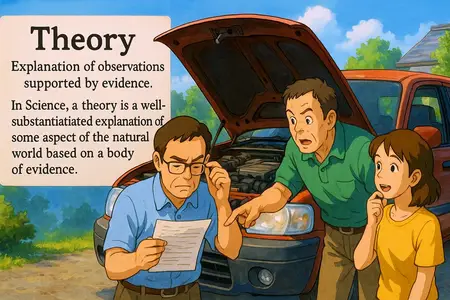
Example:
Imagine trying to figure out why your car won't start one morning. You might observe that the engine doesn't turn over when you turn the key, notice that the headlights are dim, and remember that you left the interior lights on all night. In this scenario, you're gathering evidence (dim headlights, a non-responsive engine, and the forgotten interior lights) to support your explanation that the car battery is likely dead, much like how scientists construct theories based on observations and evidence. Just as you conclude the dead battery is the reason your car won't start, scientific theories explain observations by piecing together evidence to form a coherent explanation of natural phenomena.
Practice Version
Theory: Explanation of observations supported by evidence. Theory. In Science, a theory is a well-tested idea that explains how or why something happens based on evidence.