Control
Example:
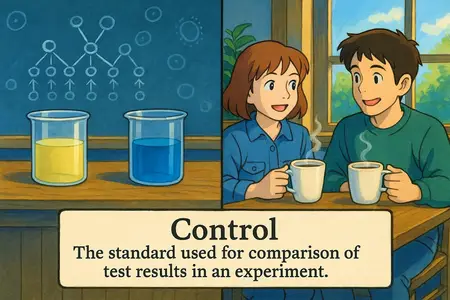
Imagine you're trying to decide if a new brand of coffee wakes you up better than your usual morning brew. Just like you would compare the new coffee to your regular one to see which is more effective, scientists use a "control" in experiments to compare test results. In this analogy, your regular coffee serves as the "control" because it sets a baseline to measure the effects of the new coffee, just as a control in an experiment provides a standard for comparison to evaluate the impact of the variable being tested.
Practice Version

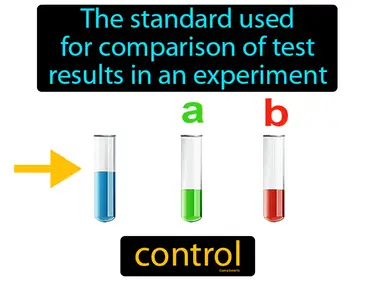
Control: The standard used for comparison of test results in an experiment. Control. In science, a control is a part of an experiment that does not change and is used to compare with the parts that do change.