Accuracy
This knowledge is used in careers such as:
Electrical Engineer (Designs Electrical Systems) ~$65,000 - $115,000 - Number of jobs: 295,000 (17,500 Openings Per Year) +7% Growth
Mechanical Engineer (Designs Machines) ~$65,000 - $115,000 - Number of jobs: 290,000 (18,100 Openings Per Year) +9% Growth
Doctor (Diagnoses and Treats Patients) ~$200,000 - $350,000 - Number of jobs: 840,000 (24,000 Openings Per Year) +3% Growth
Healthcare Tech (Administers Medical Tests & Procedures) ~$55,000 - $80,000 - Number of jobs: 270,000 (15,400 Openings Per Year) +5% Growth
Registered Nurse (Manages Patient Care) ~$65,000 - $100,000 - Number of jobs: 3,400,000 (189,000 Openings Per Year) +5% Growth
Explore These Careers →
Accuracy:
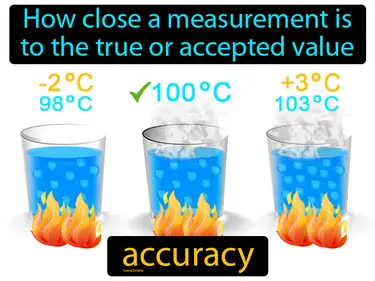
Imagine trying to hit the bullseye on a dartboard at a friend's house party. Just like aiming for that central spot on the dartboard, accuracy in measurements is about getting as close as possible to the true or accepted value. In both scenarios, whether it's hitting the bullseye or recording the correct measurement, the goal is to minimize the distance between your attempt (the dart or measurement) and the target (the bullseye or true value).
Practice Version

Accuracy: How close a measurement is to the true or accepted value. Accuracy. In Science, accuracy refers to how correct or exact a measurement is compared to the true value.