Base Unit
Base Unit:
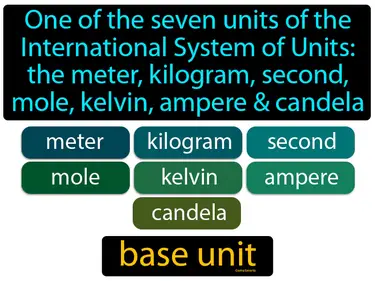
Imagine trying to bake a cake without any measuring cups or spoons. Just as precise measurements are crucial for a successful recipe, the International System of Units (SI) provides standardized measurements to ensure consistency and accuracy in science and everyday life. For instance, just like how you need specific amounts of flour or sugar to achieve the perfect cake texture, scientists use the meter, kilogram, second, mole, kelvin, ampere, and candela to accurately measure and communicate their findings, ensuring everyone uses the same "recipe" for understanding the world.
Practice Version

Base Unit: One of the seven units of the International System of Units the meter, kilogram, second, mole, kelvin, ampere candela. Base units are the fundamental units of measurement that define the standards for measuring physical quantities in science.