Melting Point
This knowledge is used in careers such as:
Teacher (Teaches Students) ~$55,000 - $95,000 - Number of jobs: 4,700,000 (324,500 Openings Per Year) +2% Growth
HVAC Technician (Installs & Repairs Heating & Air Conditioning Equipment) ~$50,000 - $90,000 - Number of jobs: 430,000 (40,000 Openings Per Year) +8% Growth
Industrial Technician (Maintains & Repairs Machines) ~$50,000 - $75,000 - Number of jobs: 540,000 (54,000 Openings Per Year) +13% Growth
Electrical Engineer (Designs Electrical Systems) ~$65,000 - $115,000 - Number of jobs: 295,000 (17,500 Openings Per Year) +7% Growth
Mechanical Engineer (Designs Machines) ~$65,000 - $115,000 - Number of jobs: 290,000 (18,100 Openings Per Year) +9% Growth
Explore These Careers →

Example:
Imagine trying to remove a stubborn, stuck jar lid that won't budge no matter how hard you twist. Just like how applying the right amount of heat can loosen the lid, reaching the melting point provides the energy needed for a solid's rigid structure to weaken and flow into a liquid state. In both scenarios, a threshold is met—twisting force for the jar and temperature for the solid—allowing for a transition from a fixed, unyielding state to a more flexible one.
Practice Version

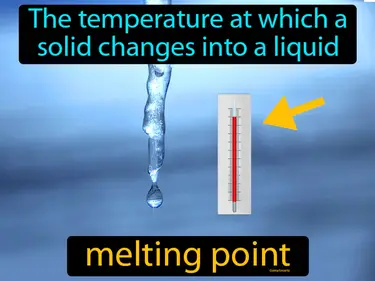
Melting Point: The temperature at which a solid changes into a liquid. Melting point. The melting point is the specific temperature where a solid substance turns into a liquid.