Grahams Law Of Effusion

This knowledge is used in careers such as:

Teacher (Teaches Students) ~$55,000 - $95,000 - Number of jobs: 4,700,000 (324,500 Openings Per Year) +2% Growth

HVAC Technician (Installs & Repairs Heating & Air Conditioning Equipment) ~$50,000 - $90,000 - Number of jobs: 430,000 (40,000 Openings Per Year) +8% Growth

Industrial Technician (Maintains & Repairs Machines) ~$50,000 - $75,000 - Number of jobs: 540,000 (54,000 Openings Per Year) +13% Growth

Electrical Engineer (Designs Electrical Systems) ~$65,000 - $115,000 - Number of jobs: 295,000 (17,500 Openings Per Year) +7% Growth

Mechanical Engineer (Designs Machines) ~$65,000 - $115,000 - Number of jobs: 290,000 (18,100 Openings Per Year) +9% Growth

Explore These Careers →

Grahams Law Of Effusion:

Imagine you're trying to catch a bus across town, but you have a heavy backpack weighing you down. Just like it's harder for you to move quickly with a heavy bag, a gas with a higher molar mass moves more slowly through a small opening. The connection here is that your speed is limited by the weight you carry, much like how the rate of effusion of a gas is slower when its molar mass is larger, demonstrating the inverse relationship in Graham's law.
Grahams Law Of Effusion Definition

Practice Version

Grahams Law Of Effusion Definition

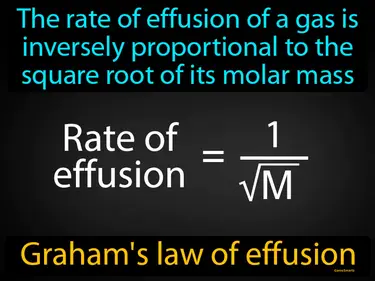
Grahams Law Of Effusion: The rate of effusion of a gas is inversely proportional to the square root of its molar mass. Graham's law of effusion states that lighter gases escape through a tiny opening faster than heavier gases.