Ideal Gas
Ideal Gas:
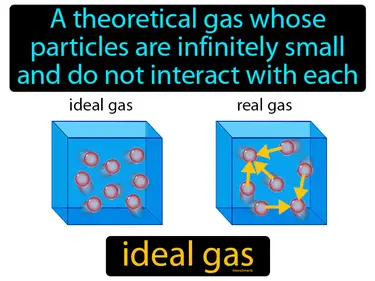
Imagine trying to organize a group of friends for a get-together where everyone is so busy that they don't have time to talk or interact with each other. This situation is similar to the concept of an ideal gas, where particles are so small and non-interactive that they move independently without influence from one another. Just as your friends are each doing their own thing without coordinating, the particles in an ideal gas move freely and independently, without any impact on each other's paths, illustrating how both scenarios rely on isolation and lack of interaction.
Practice Version

Ideal Gas: A theoretical gas whose particles are infinitely small and do not interact with each other. Ideal gas. An ideal gas is a simplified model that helps scientists understand and calculate the behavior of real gases under certain conditions.