Radioactivity

Example:
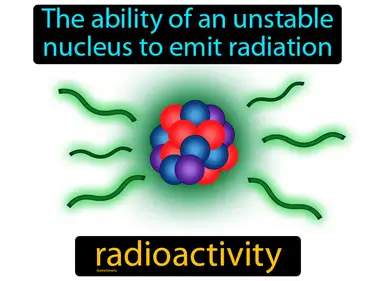
Imagine you're trying to balance a stack of books that keeps wobbling because it's not stable. Just like the stack of books, an unstable atomic nucleus is also in a precarious state and seeks stability. In both cases, the wobbly stack will eventually topple over or require you to remove some books to stabilize it, just as the unstable nucleus achieves stability by emitting radiation in the form of particles or energy, thereby altering its structure.
Practice Version

Radioactivity: The ability of an unstable nucleus to emit radiation. Radioactivity. Radioactivity is the process by which unstable atoms release energy in the form of particles or waves to become more stable.