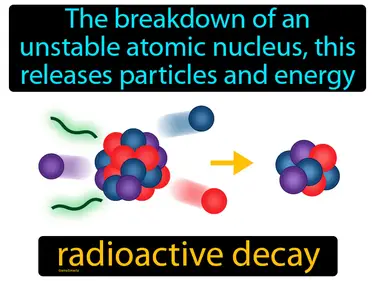
Radioactive Decay

Example:
Imagine you have a drawer stuffed to the brim with clothes, and every time you open it, a few items fall out. This is similar to radioactive decay, where an unstable atomic nucleus is like that overstuffed drawer, constantly shedding particles and energy to reach a more stable state. Just as the drawer releases clothes until it can close more comfortably, the nucleus emits particles and energy until it becomes more stable.
Practice Version

Radioactive Decay: The breakdown of an unstable atomic nucleus, this releases particles and energy. Radioactive decay. It is the process where an unstable atom loses energy by emitting particles.