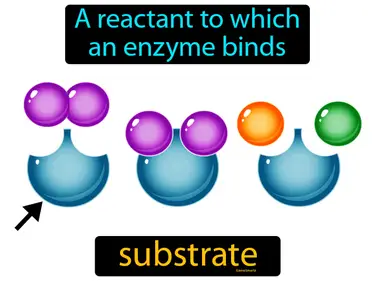
Substrate
This knowledge is used in careers such as:
Teacher (Teaches Students) ~$55,000 - $95,000 - Number of jobs: 4,700,000 (324,500 Openings Per Year) +2% Growth
Military (Operates Equipment Systems & Teams) ~$45,000 - $95,000 - Number of jobs: 2,100,000 (190,000 Openings Per Year) +2% Growth
Logistics (Runs Warehouse & Shipping Operations) ~$65,000 - $115,000 - Number of jobs: 240,000 (26,000 Openings Per Year) +17% Growth
Civil Engineer (Designs Infrastructure) ~$65,000 - $110,000 - Number of jobs: 370,000 (23,600 Openings Per Year) +5% Growth
Mechanical Engineer (Designs Machines) ~$65,000 - $115,000 - Number of jobs: 290,000 (18,100 Openings Per Year) +9% Growth
Explore These Careers →

Example:
Imagine you're trying to unlock your front door with the correct key after a long day. Just as your key is specifically designed to fit and turn the lock, a substrate is a particular molecule that fits into the active site of an enzyme, allowing a reaction to occur. In this analogy, the key represents the substrate, the lock is like the enzyme, and the process of unlocking the door parallels the biochemical reaction that takes place when the enzyme binds to its specific substrate.
Practice Version

Substrate: A reactant to which an enzyme binds. substrate. A substrate is a substance on which an enzyme acts during a biochemical reaction.