Succession

Example:
Trying to organize a messy room is a task many people face regularly. Just like tidying up involves gradual steps—starting with picking up clothes, then dusting surfaces, and finally arranging books—ecosystem succession involves gradual changes where one community of organisms slowly transitions into another. The connection is that both processes, whether organizing a room or ecological succession, involve a series of incremental changes that lead to a more stable and organized state over time, where each step builds upon the previous one to create a new order.
Practice Version

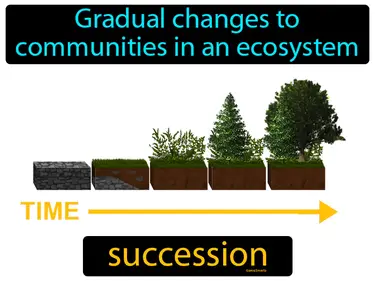
Succession: The gradual changes to communities in an ecosystem succession. Succession is the natural process where ecosystems change and develop over time.