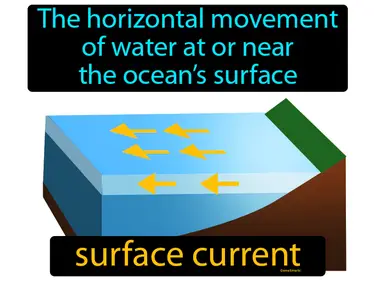
Surface Current

Example:
Imagine trying to navigate a crowded mall during a big sale, where everyone seems to be moving in different directions but eventually follows certain paths. This scenario is similar to surface currents in the ocean, where water at or near the surface moves horizontally due to various forces like wind, the Earth's rotation, and temperature differences. Just as shoppers are guided by store locations and crowd movements, surface currents are directed by the interplay of these forces, creating predictable paths in the ocean that resemble the flow of people through a bustling mall.
Practice Version

Surface Current: The horizontal movement of water at or near the oceans surface. Surface current. Surface current is the continuous flow of ocean water driven by wind, moving across the surface.