Gyre

This knowledge is used in careers such as:

Civil Engineer (Designs Infrastructure) ~$65,000 - $110,000 - Number of jobs: 370,000 (23,600 Openings Per Year) +5% Growth

Mechanical Engineer (Designs Machines) ~$65,000 - $115,000 - Number of jobs: 290,000 (18,100 Openings Per Year) +9% Growth

Industrial Technician (Maintains & Repairs Machines) ~$50,000 - $75,000 - Number of jobs: 540,000 (54,000 Openings Per Year) +13% Growth

Logistics (Runs Warehouse & Shipping Operations) ~$65,000 - $115,000 - Number of jobs: 240,000 (26,000 Openings Per Year) +17% Growth

Military (Operates Equipment Systems & Teams) ~$45,000 - $95,000 - Number of jobs: 2,100,000 (190,000 Openings Per Year) +2% Growth

Explore These Careers →

Gyre:

Imagine you're trying to clean a messy room by creating paths through the clutter to move around efficiently. Just like how your movement patterns are dictated by the furniture layout and the paths you create, ocean gyres are formed by the interaction of wind patterns and the continents that guide the water. In both cases, the flow is shaped and directed by surrounding obstacles: your room's furniture organizes your movement, while continents and wind patterns organize the ocean currents into a circulating system.
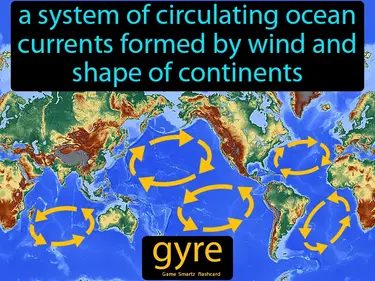
Gyre Definition

Practice Version

Gyre Definition

Gyre: A system of circulating ocean currents formed by wind and shape of continents. Gyre. A gyre is a large system of ocean currents that spiral around a central point influenced by Earth's rotation.