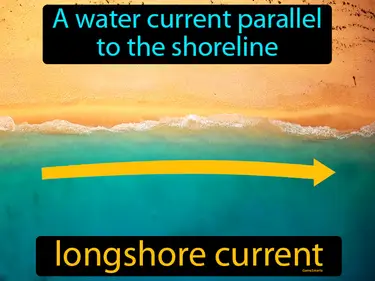
Longshore Current

Example:
Imagine trying to walk on a crowded sidewalk where everyone moves in the same direction as you, but slightly to the side, gradually nudging you along. This is similar to how a longshore current works, where the movement of water parallel to the shore slowly carries objects, like sand and debris, sideways along the coast. Just as the flow of the crowd influences your path on the sidewalk, the longshore current subtly shifts everything in its path parallel to the shoreline, guiding it along the coast just like the crowd guides you along the street.
Practice Version

Longshore Current: a water current parallel to the shoreline. longshore current. A longshore current is a movement of water along the coast caused by waves hitting the shore at an angle.