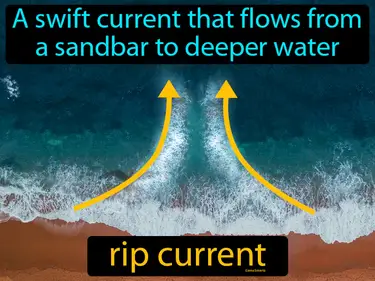
Rip Current
This knowledge is used in careers such as:
Civil Engineer (Designs Infrastructure) ~$65,000 - $110,000 - Number of jobs: 370,000 (23,600 Openings Per Year) +5% Growth
Mechanical Engineer (Designs Machines) ~$65,000 - $115,000 - Number of jobs: 290,000 (18,100 Openings Per Year) +9% Growth
Industrial Technician (Maintains & Repairs Machines) ~$50,000 - $75,000 - Number of jobs: 540,000 (54,000 Openings Per Year) +13% Growth
Logistics (Runs Warehouse & Shipping Operations) ~$65,000 - $115,000 - Number of jobs: 240,000 (26,000 Openings Per Year) +17% Growth
Military (Operates Equipment Systems & Teams) ~$45,000 - $95,000 - Number of jobs: 2,100,000 (190,000 Openings Per Year) +2% Growth
Explore These Careers →

Example:
Imagine trying to navigate a crowded parking lot where all cars are slowly moving towards the exit at once. This situation is similar to a rip current because both involve a concentrated flow of movement in a specific direction. Just as the cars funnel from a wide area into a single exit lane, a rip current forms when water from breaking waves is funneled through a narrow path from a sandbar to deeper water, creating a swift, directed flow.
Practice Version

Rip Current: A swift current that flows from a sandbar to deeper water. Rip current. It is a strong, narrow flow of water that moves directly away from the shore, posing a danger to swimmers.